A real person
FND, cerebral palsy, sarcoidosis, structural history, work, family, music, disability, and advocacy belong to one life.
Accessibility is the front door
Project Fionigan grew from knowing what it is like to make systems work—and then living with fine-motor changes that make typing and handwriting painful and sometimes unreliable, while speech, navigation, and ordinary computer steps can also change.
Created and directed by Joseph W. Korzen through Nezrok Labs Inc., Project Fionigan is an accessibility-first continuity framework that helps preserve meaning, context, source relationships, and human control across fragmented systems.
You are looking at Project Fionigan working
Joseph W. Korzen created and directs Project Fionigan. It is the continuity method used to organize this website, preserve the relationships among documents and public claims, prepare accessible explanations, support email and advocacy work, and carry approved decisions forward while typing or handwriting can cause pain.
This is not a claim that “computer-assisted accessibility created Project Fionigan.” computer-assisted accessibility may be used as a replaceable accessibility and organization tool inside a human-directed process. It is not the author, owner, Governor, reviewer, or final decision maker.
The 30-second version
FND, cerebral palsy, sarcoidosis, structural history, work, family, music, disability, and advocacy belong to one life.
Important context repeatedly broke apart across records, institutions, and live communication.
Keep the story understandable and supported while final judgment stays with a human reviewer.
First and foremost
There is a difference between learning accessibility as a standard and living the moment when a familiar task stops being dependable. On a good day, a person may type, search, organize, install, explain, and advocate. On another day, typing or handwriting may cause pain and fine-motor control, speech, stamina, or navigation may be unreliable.
The information should not disappear just because the person's access changed.
See how this website supports changing access →The diagnosis was there. The data was there. The continuity failed.
Project Fionigan keeps the person, sources, meaning, and unanswered questions connected.The two-minute version
A lifelong story involving cerebral palsy, childhood surgeries, sarcoidosis, work, family, music, disability, and later FND.
Decades of IT and data work taught how records, validation, corrections, access, and accountability should function.
Fine-motor control changed. Typing and handwriting became painful, while speech, stamina, and real-time communication could also become unreliable.
Medical, agency, legal, accessibility, and communication systems repeatedly separated information that belonged together.
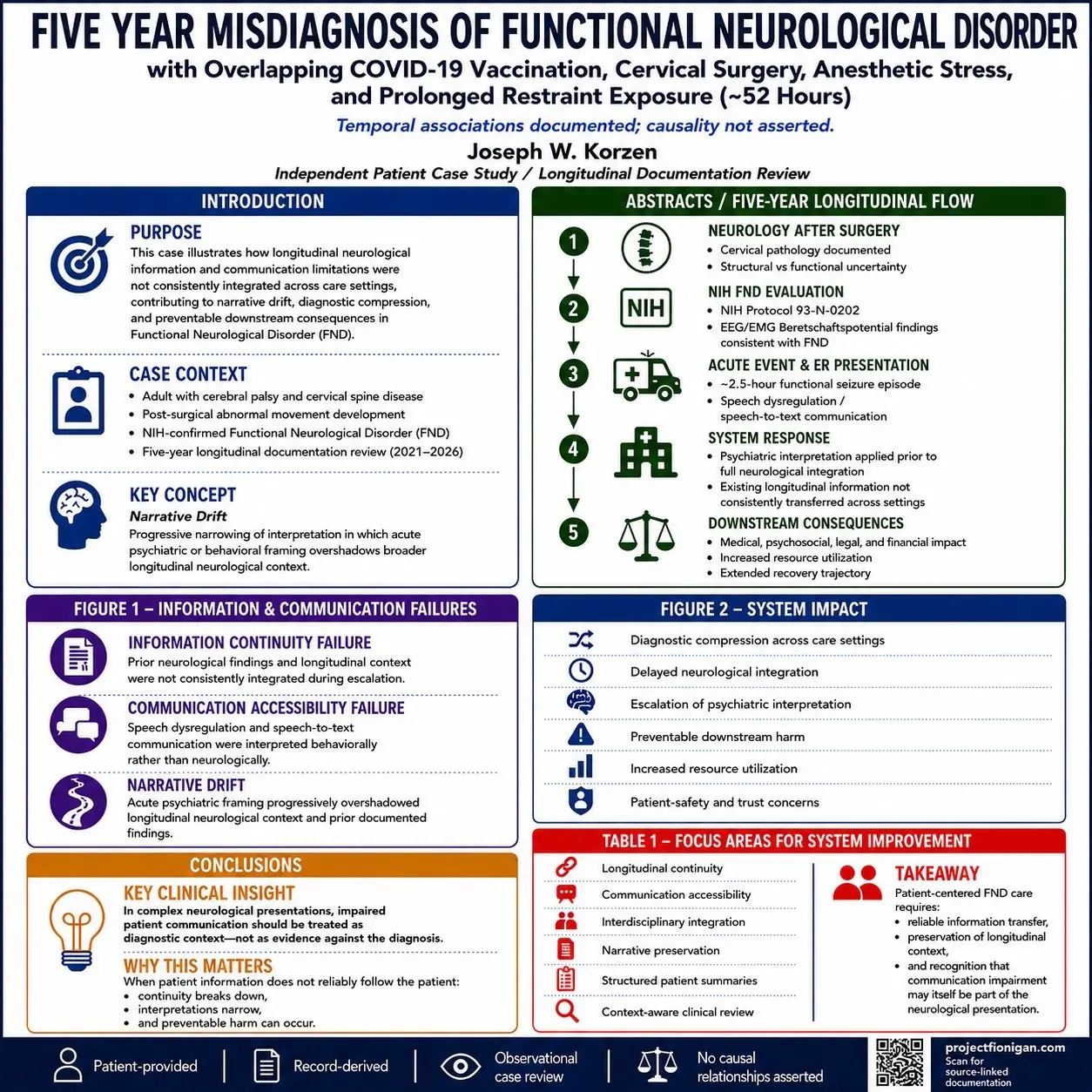
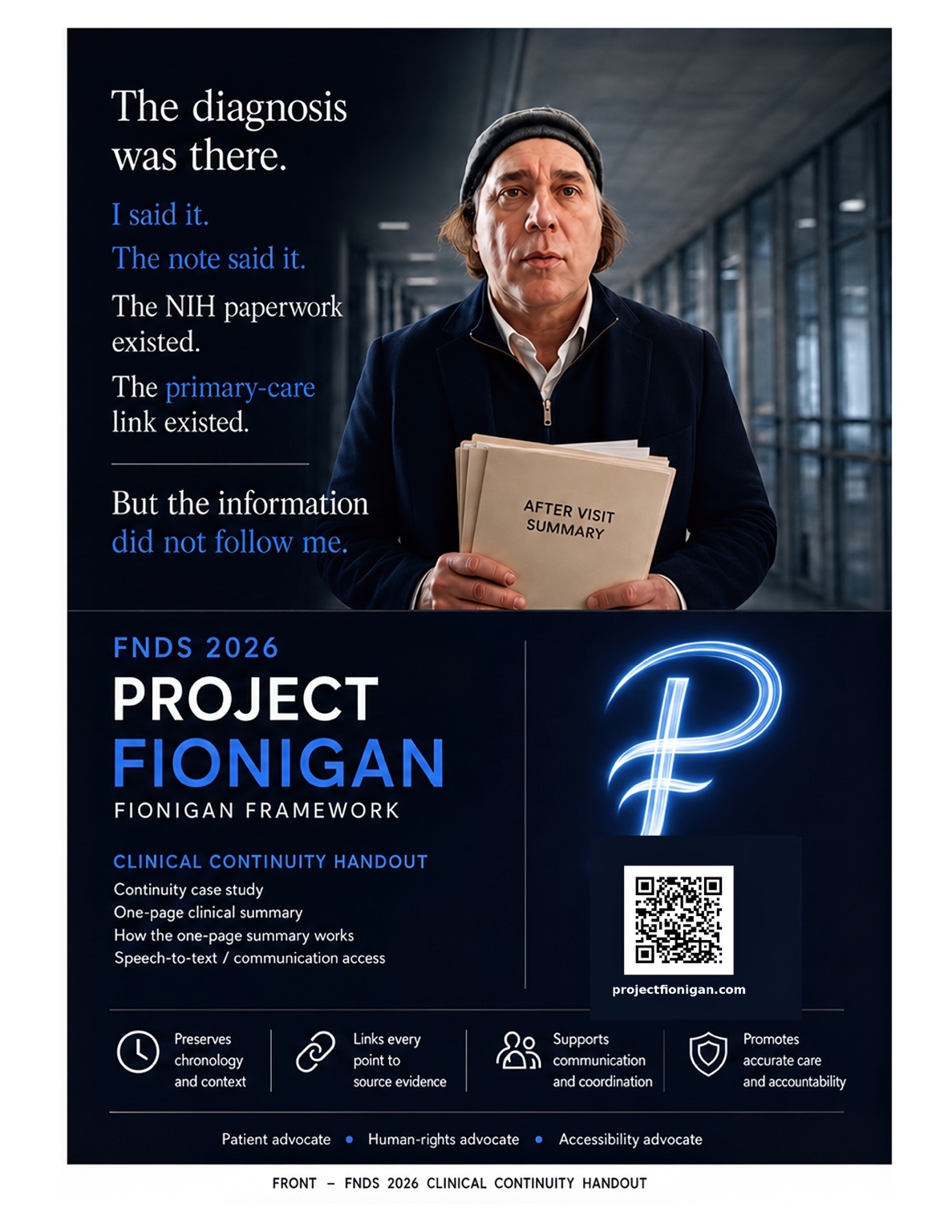
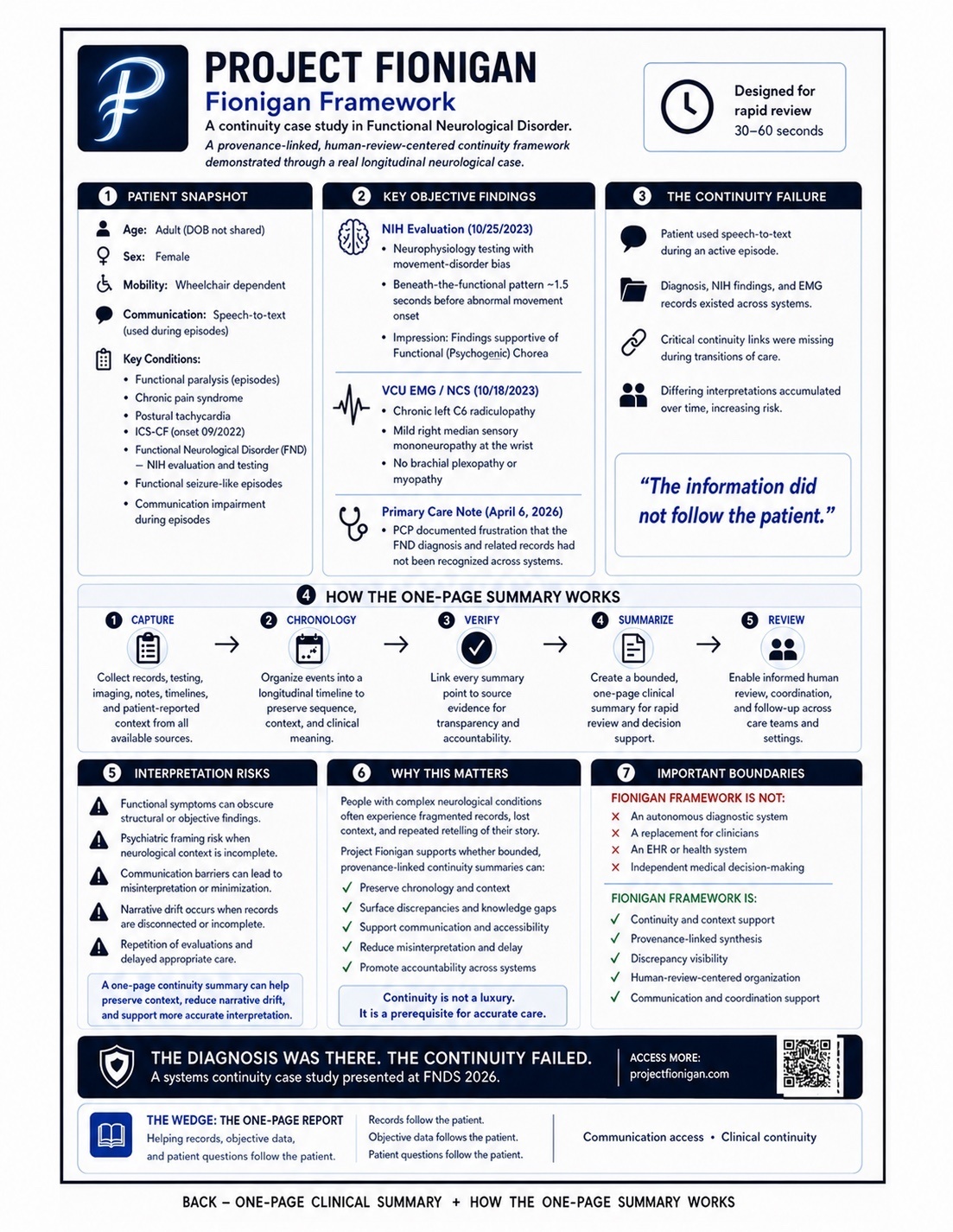
Abstract 178, the poster, the original conference handout, a one-page report, and a conference flare-up showed why a prepared continuity path mattered.
Make the story accessible, preserve context, connect it to support, and leave judgment with the human reviewer.
The public moment
The accepted abstract became a poster, an original front-and-back conference handout, and a one-page continuity report. At FNDS 2026, a real flare-up disrupted ordinary speech and live explanation. The website became the backup continuity path for the very access problem the material described.
The full website
Follow the longitudinal medical and lived story without reducing a life to one diagnosis or encounter.
Open →ResearchOpen the conference origin, poster, original handout, public explanation, and research boundaries.
Open →ContinuityUnderstand the accessibility and continuity problem without exposing confidential implementation details.
Open →AccessRead aloud, follow-yellow, larger text, spacing, contrast, search, languages, and image descriptions.
Open →OriginSee how practical systems experience and changing personal access came together.
Open →ReviewStart a public inquiry or learn how substantive private review is handled.
Open →What’s comingOpen ToneLane, mobility and access-device work, circuit and equipment-aware review, live situations, Website Factory, and data migration.
Open →What is coming
This is a high-level public overview, not a prototype release, product announcement, technical description, pricing page, or promise of availability.
ToneLane is the private audio operations and continuity lane. The public site names the lane and the human-review pattern without publishing the implementation.
Read the ToneLane boundary →Future wheelchair, wearable, field hardware, and access-device work may be named publicly at a high level. Design and development details remain private.
Read the mobility boundary →Signal-path thinking, LiveLane, RoomLane, Website Factory, and data migration packages now belong under What’s coming as public directions with private mechanics protected.
Open What’s coming →
A life larger than medicine
Recording, live sound, family, work, faith, and advocacy remain part of the person behind the framework. Project Fionigan does not erase those chapters. It keeps them in the boat.
Continue into the whole-person story →“I am not claiming certainty. I am preserving plausibility.”
Documented fact, lived observation, open question, and research possibility remain distinguishable.
Stable structure, current public site
The approved visual shell, accessibility controls, navigation, numbered sections, permanent document identities, and privacy boundary remain stable. New approved public material is integrated into the proper existing pages so the reader sees one current public site. Public means reviewed and public-redacted where needed; it does not mean private originals or third-party private data are placed in the upload package.