Research · FNDS 2026
Abstract 178 is the origin—not the entire destination.
The accepted abstract, conference poster, one-page continuity concept, lived conference event, and de-identified source trail explain why Project Fionigan exists.
The accepted abstract
Five-year misdiagnosis of Functional Neurological Disorder
Abstract 178 describes delayed FND recognition, fragmented longitudinal information, communication failure, psychiatric framing, emergency escalation, and medical-legal consequences within one patient-led case review.
The submitted abstract reflects the patient-author’s conference presentation and recommendations. It is not a clinical practice guideline.
Open the complete public Abstract 178 page ↗Conference poster
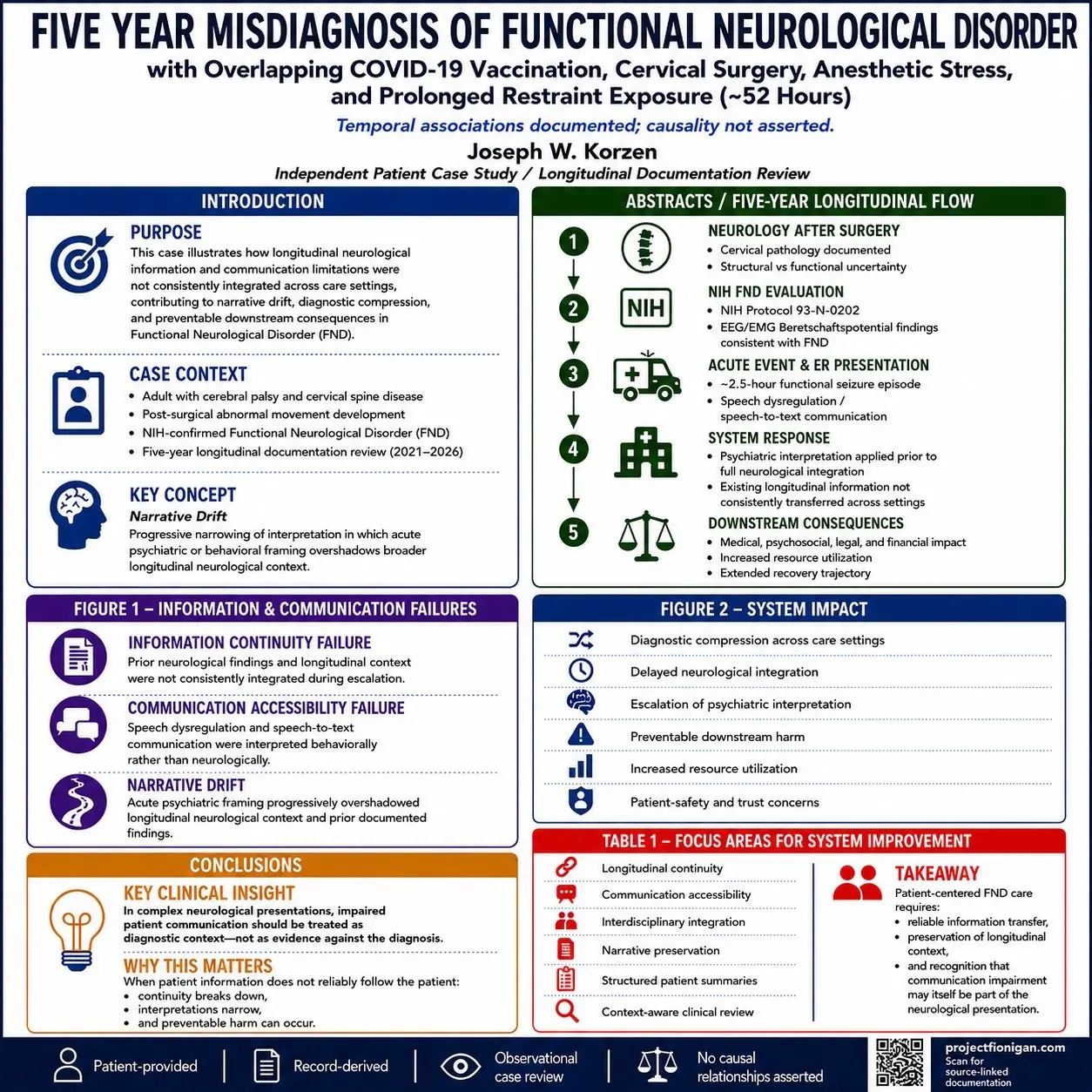
The five-year longitudinal flow at a glance
The original English poster remains the governing visual source. Its full meaning is also available in the text description beside it.
Read the complete poster description
The square poster is titled “Five Year Misdiagnosis of Functional Neurological Disorder,” with a subtitle describing overlapping COVID-19 vaccination, cervical surgery, anesthetic stress, and approximately 52 hours of restraint exposure. Directly beneath, it states: “Temporal associations documented; causality not asserted.”
The upper-left introduction defines the purpose, case context, and “narrative drift.” The upper-right panel presents a five-step flow: neurology after surgery, NIH FND evaluation, an acute event and emergency presentation, the system response, and downstream consequences.
The lower panels describe information-continuity failure, communication-accessibility failure, diagnostic compression, delayed neurological integration, escalating psychiatric interpretation, preventable harm, increased resource use, and patient-safety and trust concerns.
The conclusion identifies reliable information transfer, preservation of longitudinal context, structured summaries, communication access, interdisciplinary integration, and context-aware human review as improvement areas. The footer identifies patient-provided, record-derived, and observational material and repeats that no causal relationship is asserted.
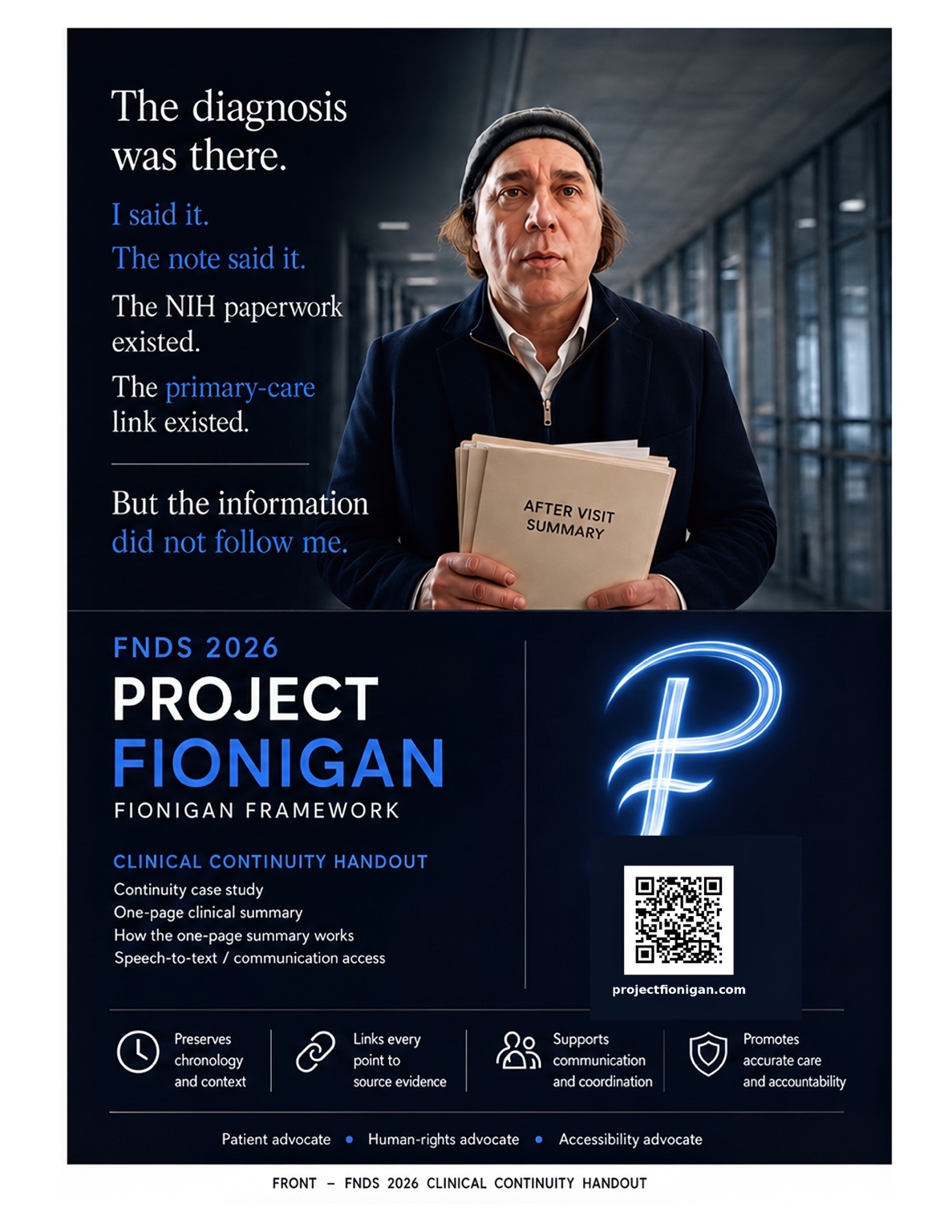
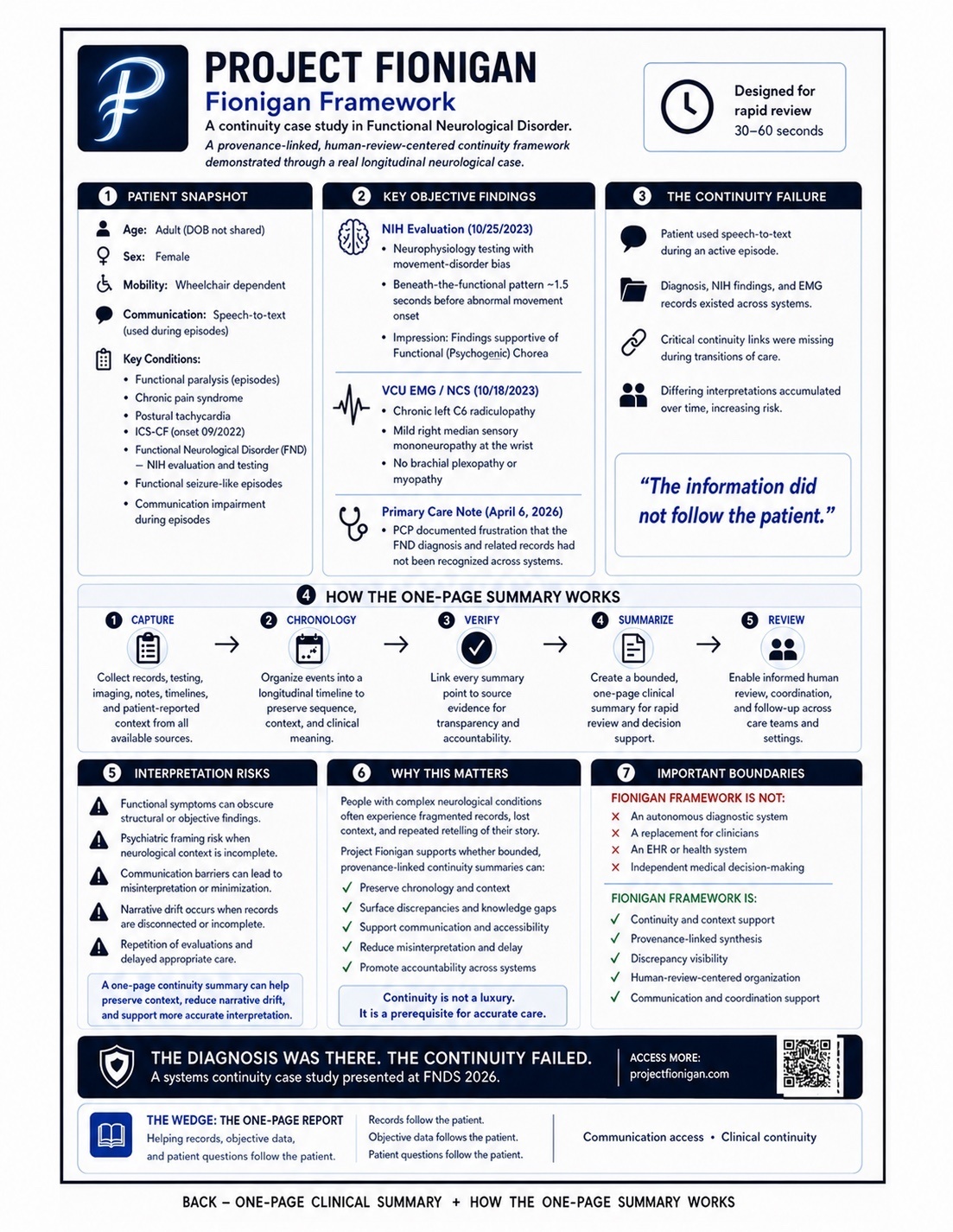
Original conference handout
The front and back belong in the conference record.
The original unedited handout is preserved as a historical public artifact. The front introduces the continuity problem and conference path. The back presents the rapid-review clinical summary and the human-review-centered workflow that accompanied the presentation.
Sources without exposure
Public claims can remain traceable without publishing raw records.
The public source layer uses de-identified descriptions, claim-to-source crosswalks, and status records. Private medical and legal originals remain private and patient-controlled.
A source description preserves what an item is, what it contains, why it matters, its provenance, and whether its physical bytes are present. It never replaces the original evidence.
Research boundary
Preserve the question without promoting it to certainty.
Lived observations, treatment responses, movement patterns, developmental history, pain changes, and plausible research questions may be organized for study. Observations remain observations until an appropriate method and source support a stronger conclusion.
“I am not claiming certainty. I am preserving plausibility.”