Front — original clinical continuity handout
Conference material
The front and back are preserved as public artifacts with an accessible text path.
Original conference handout
These are the original handout documents that were part of the website before the website changed during the conference. They are public-facing like the poster and are shown here as full unedited images.
Accessible text path
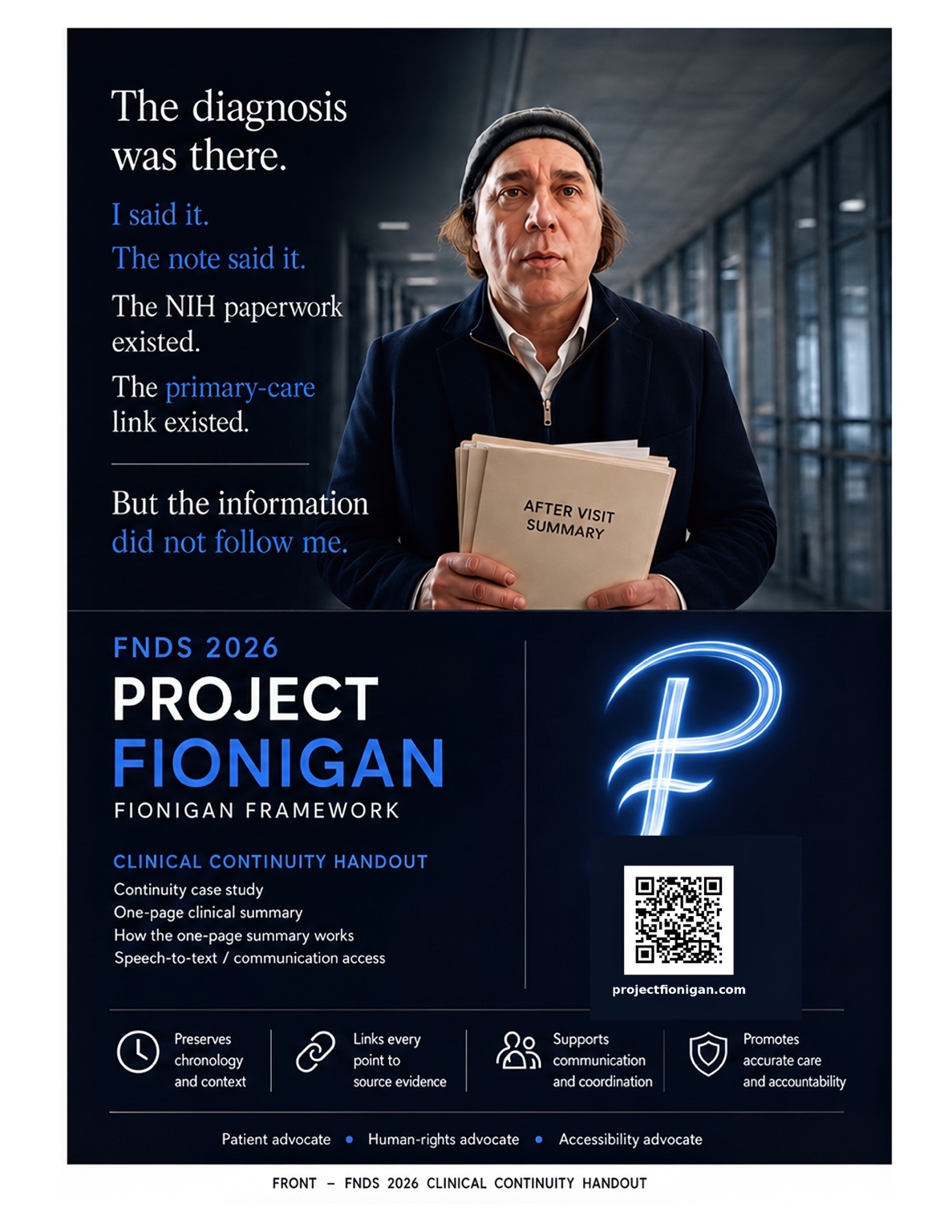
The front is a dark-blue FNDS 2026 Project Fionigan clinical-continuity handout. It shows Joseph W. Korzen holding an after-visit summary beneath the statement: “The diagnosis was there. I said it. The note said it. The NIH paperwork existed. The primary-care link existed. But the information did not follow me.”
The lower half identifies Project Fionigan and the Fionigan Framework, lists the continuity case study, one-page clinical summary, workflow explanation, and speech-to-text or communication access, and includes a QR code to ProjectFionigan.com.
Four bottom statements describe preserving chronology and context, linking points to source evidence, supporting communication and coordination, and promoting accurate care and accountability.
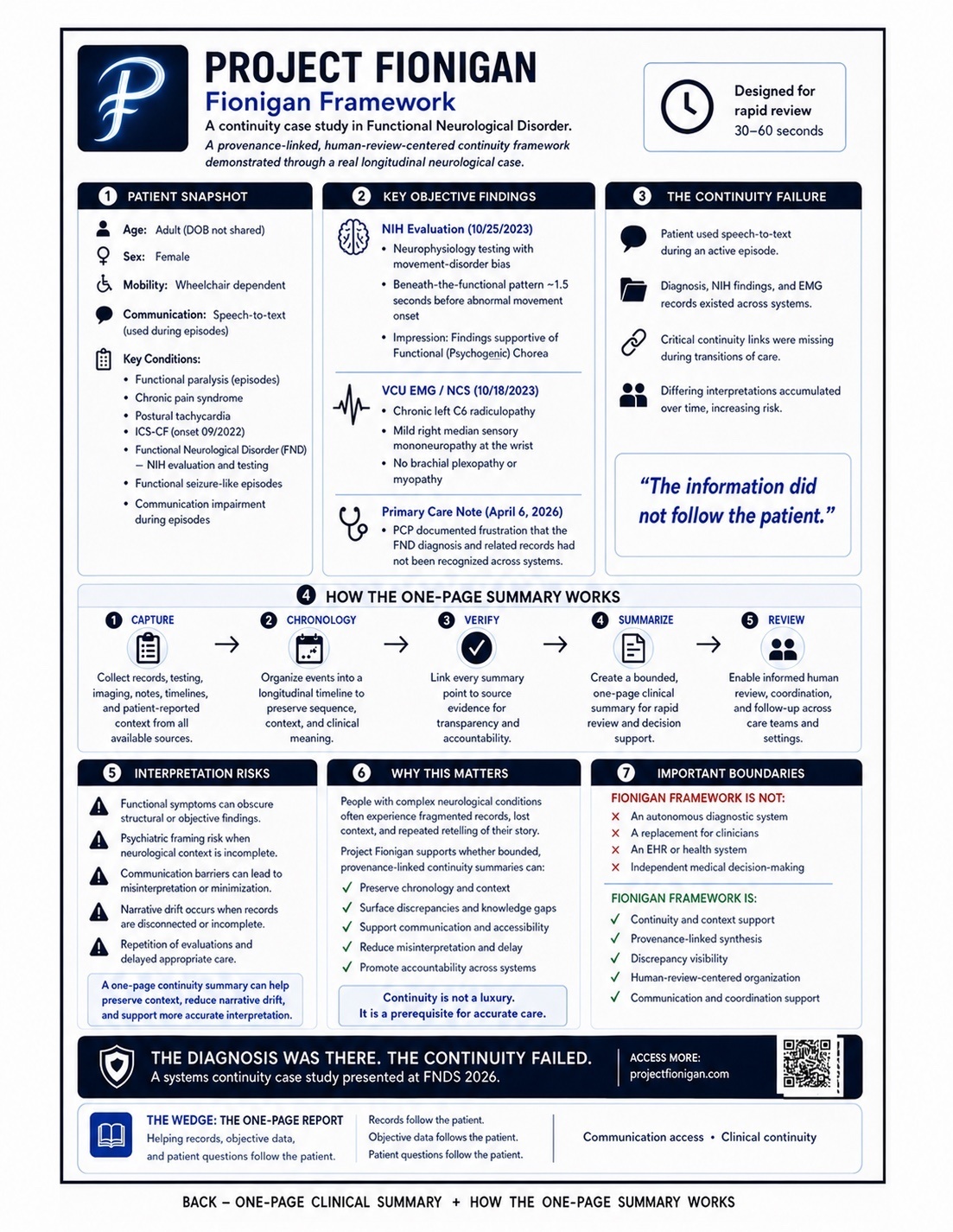
The back is a rapid-review one-page clinical summary. Its patient snapshot identifies the patient as male. It also contains an NIH evaluation, VCU EMG/NCS findings, a primary-care note, the continuity failure, a five-step capture-to-human-review workflow, interpretation risks, reasons continuity matters, and explicit limits on what the framework is and is not.
Its operating flow is Capture → Chronology → Verify → Summarize → Review. The final step is informed human review, coordination, and follow-up.
The page states that the framework is not an autonomous diagnostic system, a clinician replacement, an EHR or health system, or independent medical decision-making. It describes the framework as continuity and context support, provenance-linked synthesis, discrepancy visibility, human-review-centered organization, and communication support.